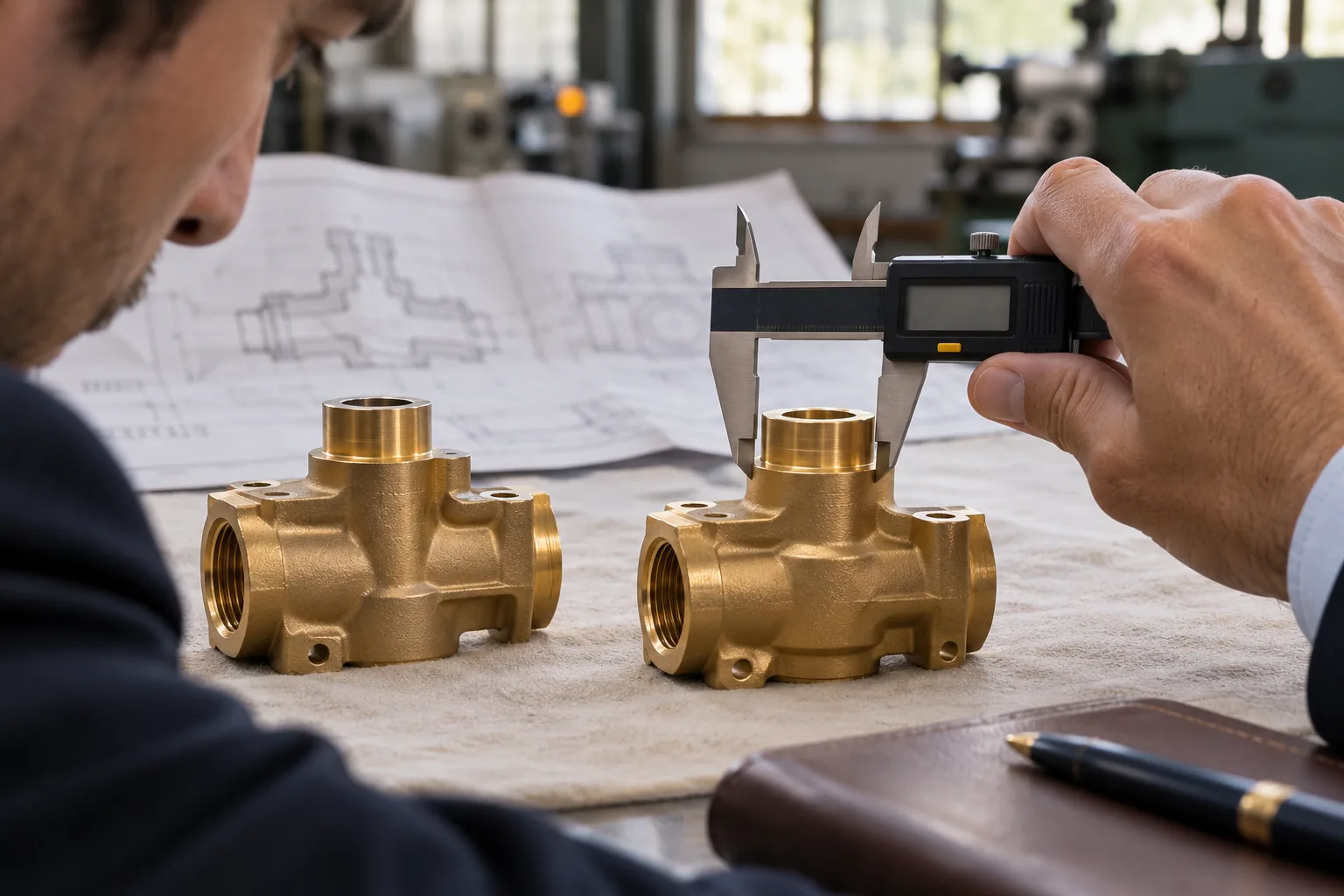
A purchasing manager approves a brass valve machined by a supplier in İzmir. The prototype fits the customer's test rig. Three months later, the first production batch fits the same rig but leaks after repeated heating. The supplier points to the signed sample. The buyer points to the temperature range in an earlier email. Each has evidence of an agreement, yet neither can immediately say which characteristic was approved. A useful sample approval records exactly what the parties tested, what they promised and what still needs verification.
For a foreign company sourcing manufactured goods in Türkiye, the United Nations Convention on Contracts for the International Sale of Goods can supply the legal framework for that discussion. This guide follows a valve from quotation to delivery and shows how commercial teams can create an intelligible record of conformity. The same method can be adapted to textiles, moulded components, furniture or packaging. The technical criteria will change with the product and its intended market.
Establish which sales rules govern the order
The Convention, commonly called the CISG, entered into force for Türkiye on 1 August 2011. Start with the parties' places of business and the conditions in Article 1. Identify the contracting entities, particularly where a buying office, production site and invoicing affiliate sit in different countries. Review any governing-law clause, express exclusion, standard purchasing conditions and competing supplier terms. Article 6 permits parties to exclude the Convention or vary its effect within its limits. A reference to Turkish law alone does not automatically establish that the parties excluded it.
Manufacturing to order can still constitute a sale. Under Article 3, the analysis changes if the party ordering the goods supplies a substantial part of the materials necessary for manufacture, or if labour or services form the preponderant part of the furnishing party's obligations. List who contributes raw stock, tooling, assembly, installation and commissioning. Distinguish physical materials from drawings or know-how and obtain advice on the actual mix. An engineering services arrangement involving a few replacement parts requires a different assessment from an order for ten thousand finished valves.
Decide what the approved sample demonstrates
Article 35 starts with quantity, quality, description and packaging required by the contract. Unless the parties have agreed otherwise, it also addresses ordinary use, particular purposes communicated at contract formation in the circumstances specified, and qualities the seller held out through a sample or model. The question is which qualities the parties reasonably associated with the object they examined. A colour swatch might establish appearance under defined lighting. It tells the buyer relatively little about a finished garment's seam strength or behaviour after washing.
Write a short approval record identifying the sample, revision, date, supplier, customer and reviewers. For each characteristic, specify whether it was measured, observed visually, tested under load or left for later validation. The valve might have approved dimensions, thread form and surface finish while thermal cycling remains outstanding. Attach the signed drawing and list the equipment used. Record an agreed tolerance rather than a broad expression such as acceptable fit. Have both sides acknowledge qualifications before the purchasing system changes the part's status to released.
Translate the intended use into measurable criteria
Tell the supplier about operating conditions that a competent manufacturer could not infer from a photograph. For a valve, relevant questions might concern fluid composition, temperature extremes, pressure cycles, cleaning agents and expected operating life. For fabric, ask about light exposure, abrasion, washing frequency and contact with skin. Article 35(2)(b) makes the timing of the communicated particular purpose and the buyer's reliance on the seller's skill or judgment relevant. Retain the explanation given before agreement and the supplier's response to it.
Then turn those conditions into a reproducible test. A requirement to withstand heat is difficult to administer. A test protocol can identify the working fluid, initial temperature, heating sequence, dwell time, pressure, cooling interval and acceptance threshold. Give each method a revision identifier. State whether the customer requires every unit to pass, a random sample from each lot, or periodic independent testing. These choices affect feasibility and price. Negotiate them while suppliers can still choose the material and manufacturing process.
Reconcile the sample with the drawing and purchase order
An approved valve has a polished outer body, but its drawing permits a brushed finish. The purchase order refers to the drawing and a product catalogue shows a polished photograph. Decide which document controls that issue. An order-of-precedence clause can help if it identifies the relevant revisions and how a later written variation takes effect. A rule that the latest email always wins can let an informal comment displace a carefully reviewed technical specification.
Use a discrepancy register during negotiations. One line identifies the conflicting documents, another records their practical effect, and a third contains the agreed resolution and responsible approvers. If a drawing changes after a quotation, ask the supplier to confirm the impact on cost, delivery and testing. Make an archived copy of each document as accepted. A shared link to a continually updated file may show today's drawing while concealing which version was available when the supplier accepted the order.
Check whether the signed approval applies to a prototype, a pilot run or ordinary production. A technician can machine a prototype from a solid block using a process that would be uneconomic at volume. Production goods may be cast, plated or assembled differently. Ask for disclosure of planned process differences that affect performance. If the buyer approves an appearance sample, describe that limited purpose expressly. If it approves tooling release subject to endurance testing, state who can authorise shipment once the endurance report arrives. For EU equipment orders, compare prototype approval with first placement of a finished machine.
Protect the reference set throughout production
Keep matching reference samples where practical. Give each a unique identifier, photograph it with a scale, mark any cosmetic defect and document the custody transfer. Specify storage conditions and a replacement procedure if the reference degrades. A rubber seal left near a heat source can harden. A textile swatch exposed to sunlight can fade. A measurement jig can wear. Record a baseline measurement or photograph before deterioration makes a later comparison misleading.
For dimensional features, confirm the measuring technique as well as the tolerance. Two inspectors can reach different conclusions if one measures across a burr or clamps a flexible component too tightly. Define datum points, fixture orientation, calibration requirements and permissible measurement uncertainty. Explain how to resolve borderline results. An independent laboratory may be appropriate for a specialised dispute. Agree who can attend the test, whether testing consumes the sample and who receives the raw observations alongside the final certificate.
Give substitutions a controlled approval path
A common disagreement begins with an apparently harmless substitution. A resin grade becomes unavailable; the supplier proposes another with a similar data sheet. The purchasing team wants the delivery date maintained. Before authorising the switch, record the affected part numbers, stock on hand, first production lot and characteristics that need revalidation. Consider colour stability, chemical resistance, export documentation and any customer-specific approval. Engineering and procurement may have different authority to accept a technical deviation or an additional charge.
Set an expiry or quantity limit for any temporary concession. If the buyer permits two hundred units while the specified material is unavailable, record what happens after those units ship. Ask for segregation, lot traceability and a dispatch list. Keep the substitute sample distinguishable from the original reference. Otherwise a single emergency arrangement can be mistaken for permanent acceptance. When the original material returns, check that the production line, purchasing database and inspection sheet have all reverted to the agreed specification.
Organise examination and notice at delivery
Under Article 38, the buyer generally must examine the goods or have them examined within as short a period as practicable in the circumstances. The article contains rules for carriage, redirection and redispatch. Build an inspection arrangement around the actual delivery route. If a distributor receives sealed cases and forwards them immediately, identify who can open them, perform checks and alert the contracting buyer. An agreement with the distributor cannot by itself alter obligations owed to the seller.
Article 39 generally requires notice specifying the nature of the lack of conformity within a reasonable time after discovery or when the buyer ought to have discovered it. It also sets a two-year outer limit from actual handover, subject to inconsistency with a contractual guarantee period. That outer limit is a different question from the reasonable time for notice and from the limitation period for starting proceedings. Get advice promptly where facts, contractual terms, reservations or exceptions may affect the analysis. Article 40, for instance, addresses certain facts known to the seller or of which it could not have been unaware and which it failed to disclose.
A workable notice identifies the order, lot, quantity inspected, serial numbers, failure observed, test method, date and location. Explain whether remaining units are quarantined and invite the seller to inspect. Preserve proof of transmission and the response. A message reporting that customers are unhappy gives the supplier little opportunity to investigate. A specific description of three leaking seats after a defined heating cycle allows an engineer to identify affected production and propose a test. Keep later measurements as dated supplements to the first notice.
Plan a remedy without destroying the evidence
When a defect stops a line, commercial teams will want a replacement immediately. Preserve representative failed and unaffected units, the reference sample, raw test data and contemporaneous photographs. Ask a technician to separate observed conditions from possible causes. Cast porosity, installation torque and incompatible coolant may produce superficially similar symptoms. Obtain the seller's response before destructive testing where circumstances allow. Record urgent protective steps, their costs and why waiting for a joint examination was impractical.
CISG remedies depend on the facts and their specific requirements. Articles 46 and 48 address performance and cure, Article 50 addresses price reduction, and Articles 74 and 77 concern damages and mitigation. A failed inspection does not automatically entitle a purchaser to replacement of every unit, rejection of an entire contract or recovery of all downstream penalties. Separate the technical scope of the defect from the legal basis for the requested remedy. Prepare a schedule of repair, freight, retesting, sorting and salvage with supporting invoices. Flag upgrades or unrelated improvements so that a negotiated settlement can be reconciled to the loss.
Hand over a record a new buyer can use
Before renewing the contract, ask a colleague who missed the original negotiation to retrieve the approved drawing, identify the reference sample and explain the outstanding test. Give them one shipped lot and ask them to trace it back to material certificates, concessions, test results and inspection records. Note where they have to telephone the original engineer for an undocumented answer. Those gaps tell the parties exactly which parts of the purchasing process need a clearer record.
The useful end product is a short, signed description of the promise and a dependable way to verify it. Procurement knows what it purchased. The manufacturer knows what will be inspected. If a disagreement arises, both parties can begin with the same part, the same revision and the same test conditions. That shared starting point often makes a practical repair or replacement possible before a legal claim has to carry the whole dispute.
Frequently asked questions
Can a buyer approve the appearance of a sample while reserving functional tests?
Define the approved characteristics and pending tests in a written record accepted by both parties. Identify who releases production or shipment after the outstanding checks.
What should a defect notice identify?
Give the supplier the order, affected goods, lot numbers and observed lack of conformity. Preserve the timing, method and evidence of transmission.