Back to Map

Law Firm in Türkiye for United States Companies

When a United States corporation expands its manufacturing, technology, or supply chain relationships into Türkiye, it enters a legal system that operates entirely outside the North American or European judicial networks. Your commercial contract might name New York or Delaware law, but if a dispute arises, a US court judgment cannot automatically seize assets or freeze a bank account in Türkiye.

There is no bilateral enforcement treaty between the United States and Türkiye. This means every legal step taken to recover funds, enforce intellectual property, or manage corporate subsidiaries must be handled directly on the ground. We provide professional legal services for US companies from our offices in Bursa and Istanbul, translating American commercial requirements into effective local enforcement actions.

US Corporate Legal Operations in Türkiye

Core Legal Services and Operations

Protecting US corporate capital directly where it is deployed.

Request a Consultation

Connect with our United States desk directly.

Subsidiary Setup and Corporate Counseling

  • We serve as local legal architects for US corporations launching or modifying business vehicles in Türkiye.
  • We manage the formation of local limited liability or joint-stock companies, customize corporate bylaws to safeguard US voting controls, handle board appointments, and manage annual general meetings remotely.

Cross-Border Asset Recovery and Financial Enforcement

  • We specialize in aggressive asset tracing and commercial debt collection for US creditors.
  • Because US judgment execution requires strict reciprocity verifications, we focus on protecting assets early through court-ordered preliminary attachments (İhtiyati Haciz), directly locking down bank accounts and warehouse inventories to secure US financial claims.

IP Protection and Trademark Litigation

  • We defend US intellectual property assets against local infringement, counterfeiting, and bad-faith domain registration.
  • Our team handles local patent and trademark filings, coordinates customs enforcement seizures, and litigates IP disputes before specialized Turkish IP courts.

Data Privacy, Governance and Cross-Border Transfers

  • For US enterprises utilizing global servers or sharing consumer and employee data between Turkish operations and US corporate networks, compliance with Türkiye's data privacy act, the Turkish Personal Data Protection Law (KVKK), is mandatory.
  • We audit your international data flows, enroll US-based data controllers in the mandatory VERBIS database, draft specialized local explicit consent forms, and adapt your existing GDPR or US data frameworks to satisfy strict local statutory structures.

Tactical Realities: Managing US Capital and Risk

State-by-State Reciprocity and Enforcement

To collect a debt using a US court judgment in Türkiye, you must file a formal enforcement lawsuit (Tanınma ve Tenfiz) under Law No. 5718 (MÖHUK). Because there is no federal treaty, Turkish commercial courts evaluate judicial reciprocity state by state. Judgments from states with a history of enforcing Turkish rulings, such as New York, California, or Texas, are on solid ground. Judgments from states without this documented history can face significant hurdles. We evaluate your judgment's collectability before you spend money on enforcement.

The Parallel Protection Strategy in Arbitration

Due to the complexities of enforcing foreign state judgments, many US contracts rely on AAA/ICDR, ICC, or SMA arbitration clauses. A major tactical point often missed by US legal teams is that an international arbitration clause does not strip your right to obtain emergency protections from a local Turkish court. While your main dispute is being arbitrated in New York, we can concurrently apply for a preliminary attachment (İhtiyati Haciz) in Türkiye to freeze the manufacturer's local assets and bank accounts, ensuring you do not win an empty arbitration award.

Trade Registry and Sister Entity Risks

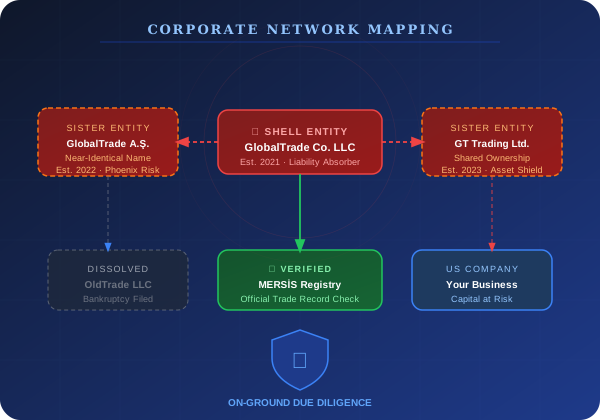
US companies routinely transfer massive deposits based solely on website verification and proforma invoices. They often do not realize that a local supplier might be operating under a near-identical corporate name engineered to absorb liability and dissolve when a breach occurs. We run independent, on-the-ground corporate mapping to expose phoenix-company networks, verifying who actually owns the manufacturing facilities before your funds leave your US account.

Secure Asset Protection in an Active Dispute
Trade Registry and Sister Entity Risk Mapping

Overcoming Local Procedural Hurdles

01

Managing the Financial Security Deposit

Under Turkish procedure, foreign plaintiffs must generally post a cash security deposit (teminat) to cover court costs before their lawsuit can proceed. Because US reciprocity is evaluated on a state-by-state basis, Turkish commercial courts can rule both ways regarding this requirement for US entities. We address this hurdle immediately at the outset of your file by presenting specific state precedents to eliminate or minimize these capital ties, preventing sudden procedural dismissals.

02

Executive Corporate Power of Attorney (POA)

We manage your local litigation, contract signings, or subsidiary affairs completely remotely without requiring your corporate officers to travel. You can execute a broad-authority corporate POA through primary method: before a local US notary public, followed by a State Secretary Hague Apostille. We pair the POA with a recent certified Certificate of Good Standing to verify signing authority.

Fixed-Scope Corporate Services

Pre-Contractual Supplier Verification

We conduct a full due diligence review of prospective Turkish partners within 48 hours. This includes checking official trade registry records, active litigation or bankruptcy filings, tax compliance status, and verifying the physical manufacturing plant on-site.

Request a Supplier Verification Check

Contract Risk and Enforcement Audit

We review your supply, distribution, or joint venture agreements under Turkish enforcement standards to ensure your choice of law, Incoterms, and payment mechanisms provide actual security when tested in local commercial courts.

Order a Contract Risk Audit

US Diplomatic Missions in Türkiye

For official corporate filings, consular notarizations, or federal documentation, your operational teams can reference the following US diplomatic sites:

US Embassy Ankara

Çukurambar Mahallesi, 1480 Sokak No: 1, Çankaya, Ankara.

US Consulate General Istanbul

Poligon Mahallesi, Sarıyer Caddesi No: 75, İstinye, Sarıyer, İstanbul.

US Consulate Adana

Girne Bulvarı No: 212, Yüreğir, Adana.

Operational Procedure

Operational Procedure Average Duration Key Legal Factor
Subsidiary Incorporation 5 to 7 Business Days Requires notarized and apostilled US corporate entity documents.
Commercial Litigation 12 to 18 Months Financial security deposit requirements vary based on US state reciprocity.
Asset Freezing (Attachment) 48 to 72 Hours Requires rapid documentation of breach and active bank account tracking.
Data Privacy Global Mapping 2 to 3 Weeks Restructures international corporate cloud sharing to align with local data acts.

Disclaimer: While bilateral treaties guarantee specific international protections, local judicial interpretations and court backlogs may vary case-by-case. Securing an early, structured legal assessment is strongly recommended prior to executing significant cross-border transactions.

Frequently Asked Questions

Common legal inquiries from US corporate clients operating in Türkiye.

1. We are a US company. How can we issue a Power of Attorney to your law firm?

You can execute a Power of Attorney before a local US Notary Public. It must then receive a Hague Apostille from the appropriate State Secretary of State. Alternatively, your corporate officers can visit the Turkish Embassy or Consulate in the US to issue the document directly in Turkish, saving time on translations.

2. Are US federal or state court judgments directly enforceable in Türkiye?

No. There is no bilateral enforcement treaty between the US and Türkiye. A US judgment requires a formal recognition and enforcement lawsuit (Tanınma ve Tenfiz) in a Turkish court under Law No. 5718 (MÖHUK), and reciprocity is evaluated on a state-by-state basis.

3. How long does it take to establish a US-owned subsidiary in Istanbul?

Typically 5 to 7 business days once we receive your original, notarized and apostilled US corporate entity documents and board resolutions in Türkiye.

4. Can we freeze a Turkish supplier's assets if they breach our contract?

Yes. Through a preliminary attachment (İhtiyati Haciz), we can often secure court orders to freeze bank accounts, warehouse inventories, and real estate within 48 to 72 hours if there is strong, documented evidence of the debt and risk of asset dissipation.

5. Are US companies required to pay court security deposits in Türkiye?

It depends. Because there is no federal treaty, Turkish courts evaluate reciprocity state by state. Courts can rule both ways on the security deposit requirement for US entities. We present specific state-level precedents at the outset to eliminate or minimize this requirement.

6. Does an arbitration clause prevent us from getting emergency protections in Turkish courts?

No. An international arbitration clause does not strip your right to obtain emergency protections from a local Turkish court. While your main dispute is being arbitrated in New York, we can concurrently apply for a preliminary attachment in Türkiye to freeze the opposing party's local assets.

7. Does a Turkish subsidiary need a local Turkish director?

No. A Turkish Joint Stock Company (A.Ş.) or Limited Liability Company (Ltd. Şti.) can be 100% owned by your US parent company, and US citizens can serve as sole directors.

8. Is US data privacy compliance (e.g., CCPA) recognized in Türkiye?

No. Türkiye operates under its own data protection law (KVKK). You cannot rely solely on US or GDPR compliance. You must fulfill local obligations, including potential registration with the Turkish data controllers' registry (VERBIS) and executing specific cross-border data transfer agreements.

9. How do we verify a Turkish business before sending a large payment?

We conduct rapid due diligence within 48 hours, checking the official Trade Registry (MERSİS), litigation records, bankruptcy status, tax compliance, and performing physical site visits to verify the company's legitimacy and protect your capital.

10. What is the risk of phoenix companies in Turkish trade?

It is a significant risk. Some local suppliers operate under near-identical corporate names designed to absorb liability and dissolve when a breach occurs. We run independent, on-the-ground corporate mapping to expose these networks and verify ultimate beneficial ownership before your funds are transferred.

11. Are there tax treaties between the United States and Türkiye?

Yes, the United States and Türkiye have a Double Taxation Avoidance Agreement. When structured correctly, this treaty optimizes the tax burden on dividend repatriations, royalties, and corporate service fees between the two jurisdictions.

Schedule a Consultation

Submit your inquiry below and our relevant desk will respond within 24 hours.